Performances
WNO’s “Little Prince” brings seasonal holiday magic for all ages
Francesca Zambello conceived of a family-oriented opera based on Antoine de […]
Grosvenor scales the heights with a trio of blockbusters for Chamber Music Maryland
Chamber Music Maryland brought Benjamin Grosvenor back to the Horowitz Center […]
Shaham helps Wolf Trap celebrate a barn tricentenary with well-balanced program
Three hundred years ago, a German immigrant built a barn for […]
Concert Opera puts the Greek tragedy back into opera with Gluck’s “Iphigénie”
Washington Concert Opera opened its three-opera season with another admirable rarity, […]
Les Arts Florissants, violinist de Swarte deconstruct Vivaldi’s “Four Seasons” at Library of Congress
The resolution to the budget standoff in the U.S. Senate two […]
Articles
Patrick Quigley to open new Opera Lafayette era with a fresh look at “Dido and Aeneas”
At the end of Opera Lafayette’s 30th season last May, founder […]
Critic’s Choice
Lawrence Brownlee, Erin Morley, and Gerald Martin Moore. Vocal Arts DC. […]
Concert review
Bach Consort’s “Christmas Oratorio” rings in the season in joyous fashion
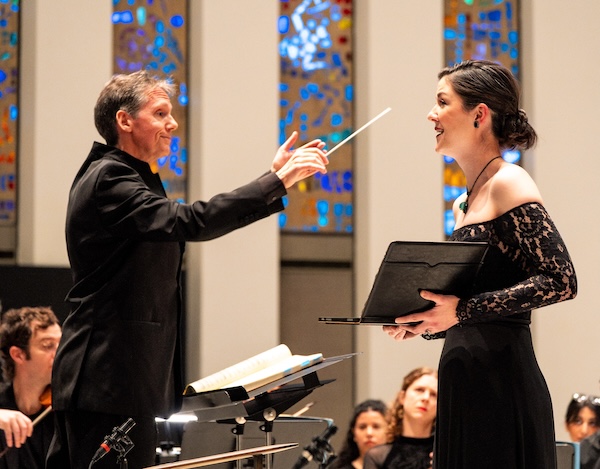
Dana Marsh conducted the Washington Bach Consort in the Christmas Oratorio Saturday with mezzo-soprano Sylvia Leith among the soloists. Photo: Mauricio Castro
Dana Marsh conducted Bach’s Christmas Oratorio when he made his first appearance with the Washington Bach Consort, back in 2017. After that audition and his appointment as the ensemble’s artistic director, Marsh has made the work a December tradition, presented this year in cooperation with Washington Performing Arts.
Marsh led this year’s installment Saturday afternoon in the solemn, cavernous space of National Presbyterian Church, filled to the brim with a devoted audience.
When Bach created the work, repurposing largely secular music for the Leipzig Christmas season of 1734 to 1735, he took six feast days to perform it, spread over the two-week period from Christmas to Epiphany. As he did with many cantata cycles throughout his long career, the composer made connections of key, instrumentation, and symmetry among the six cantatas. Scholars have long agreed on its cohesion as a larger work.
At its full length, however, the piece takes around three hours to perform. Marsh has generally preferred truncating it to four or five of the six cantatas. This year a long intermission replaced Part IV, a regrettable loss. (Only during the Covid pandemic, in December 2020 to January 2021, did the ensemble perform all six cantatas, virtually and singly, on the feast days of Bach’s original plan.)
In the solo quartet Bach gave the central role to his mezzo-soprano. Sylvia Leith brought a plummy, opulent vocal tone to these crucial arias, especially in Part II’s “Schlafe, mein Liebster,” the oratorio’s finest. Velvety legato articulation and some flashy ornamentation adorned Part I’s “Bereite dich, Zion,” another highlight. In both cases Marsh could have kept the orchestra down more, so as not to cover his singer. Up against only solo violin and the demure continuo group, by contrast, Leith’s interpretation of Part III’s “Schliesse, mein Herze” excelled most of all.
Tyler Duncan sang the bass solos with impressive force and subtlety. His diction was natural in the recitatives, and his voice sounded even and rounded across its wide range, down to solid low notes in Part I’s “Grosser Herr.” Duncan and trumpeter Josh Cohen added vibrant embellishments in that aria.
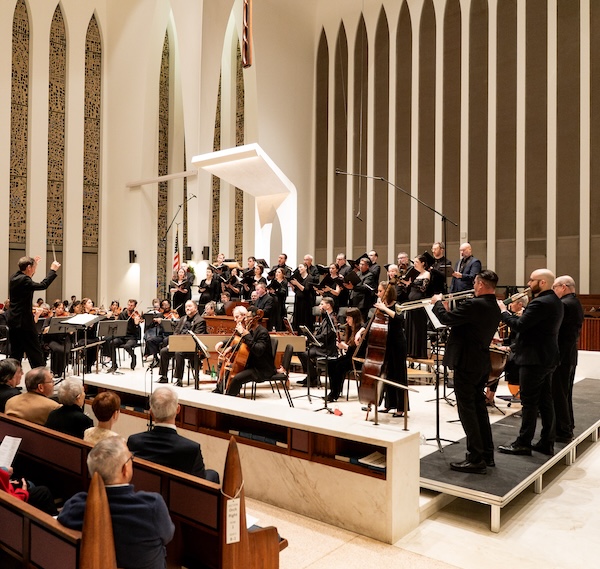
Photo: Mauricio Castro
Hannah De Priest gave bright, airy renditions of the smaller number of soprano pieces, especially vivid in the Angel’s exhortation in Part II. Her duet with Duncan in Part III’s “Herr, dein Mitleid” proved a highlight of the concert, with both singers creating admirable balance between their voices, both at soft and loud extremes, interwoven with fine playing from the two musicians on oboes d’amore. Leith humorously chastised both for their chattering lines in the Terzetto in Part V, “Ach, wenn wirt die Zeit.” De Priest’s main solo event, the recitative and aria of Part VI, came off with charming musicality as well.
Thomas Cooley sang both the tenor arias and the Evangelist’s recitatives, a doubling up that led to him being the only soloist who did not also sing in the choruses. His top range easily reached the high stretches of the Evangelist’s narration, with plenty of power to fill the nave from his place next to Marsh. His intonation occasionally strayed, especially when the continuo dropped out, and the melismatic passages smudged together.
Marsh’s confidence with the score and his rapport with the orchestra have grown over the course of his tenure. Concertmaster Andrew Fouts’s violin at times sounded too subdued for his solo obbligati, while the shepherds’ pipes, a quartet of oboes d’amore and bleating oboes da caccia, made a rustic contribution to Part II. The alternation of chamber organ and harpsichord enlivened the continuo part considerably.
The Bach Consort’s twenty singers brought accustomed balanced sound and clarity of German diction to the work’s most important sections, the choral numbers. Even the lowly chorales received an elegant and poised treatment, appropriate to the theological weight they bear in Bach’s overall structure. The movements in which Bach wove together a chorale tune with recitative commentary came across as especially revelatory as a result.
Long may this new tradition, a welcome antidote to the endless round of Handel’s Messiahs this time of year, flourish in the nation’s capital.
Washington Bach Consort inaugurates another new annual tradition, a celebrity organ recital, with a concert by James O’Donnell, formerly of Westminster Abbey, playing all of Bach’s Clavierübung III 7 p.m. February 27. bachconsort.org
Calendar
December 14
Washington National Opera
Portman: The Little Prince
WNO Youth […]
News
Washington Classical Review wants you!
Washington Classical Review is looking for concert reviewers in the DC […]
Vienna Philharmonic to visit Kennedy Center
After raising an all-time-record $3.45 million at its first NSO Gala, […]